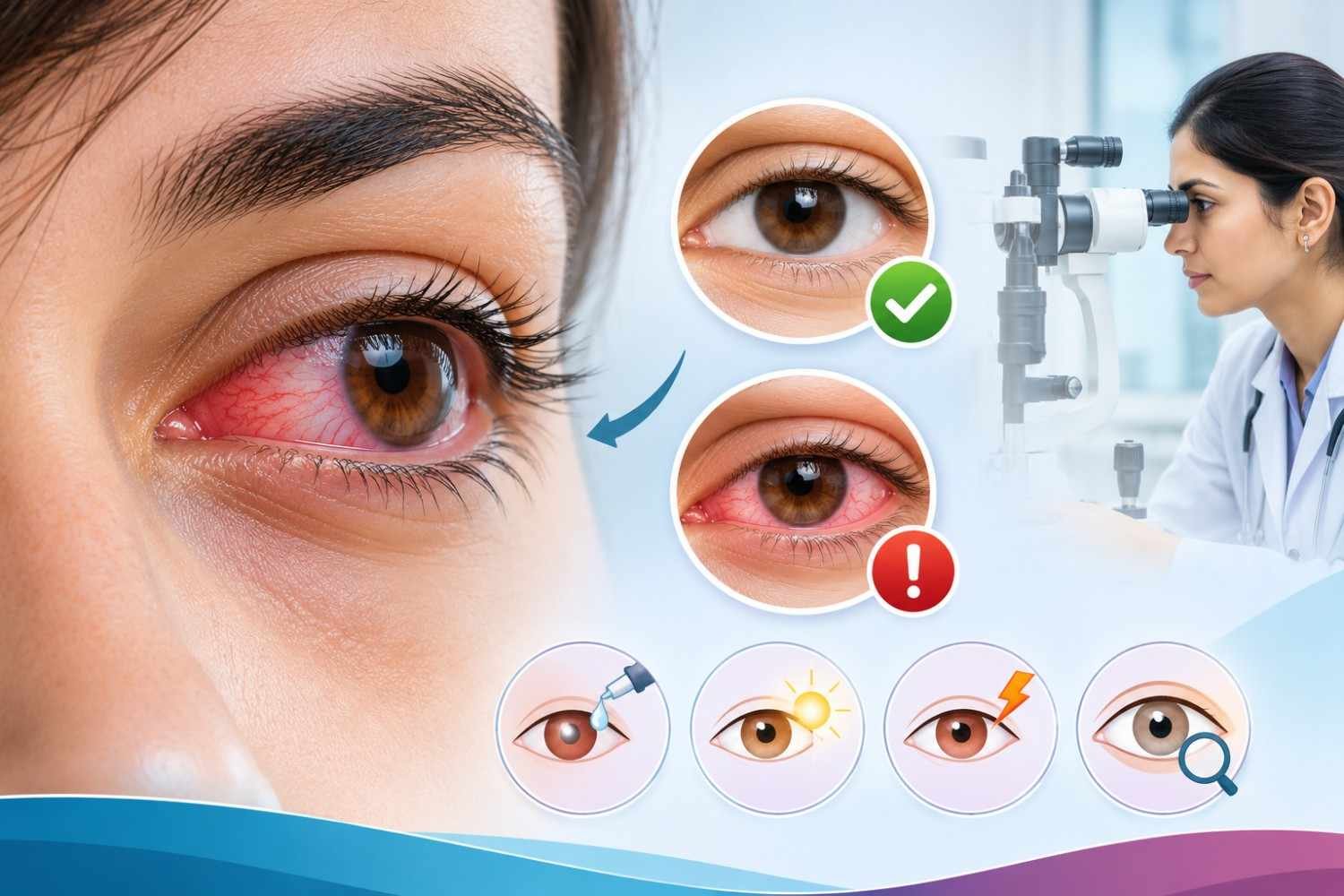
Red Eye Isn’t Always Conjunctivitis: How to Tell When It’s Serious
Almost everyone has had a red eye at some point. Most of the time it is minor: dust, dryness, an allergy, or conjunctivitis (often called pink eye), which usually settles on its own. But a red eye can also be the first sign of a problem that threatens sight, such as a corneal ulcer, uveitis or acute angle-closure glaucoma. The difference usually lies in what comes along with the redness. This guide explains how to tell them apart, and when not to wait.
Quick answer
A red eye is usually minor if it is painless, vision is normal and it improves within a few days. See a doctor urgently if the red eye is painful, or comes with reduced or blurred vision, light sensitivity, halos around lights, severe headache or nausea, or follows an eye injury.
Why Is My Eye Red?
The white of the eye turns red when the tiny blood vessels on its surface become swollen. This can happen because of dryness, sun, dust, allergies, infection, inflammation or injury. Doctors separate red eyes into two broad groups: painless red eyes, which are usually minor, and painful red eyes, which can be serious and need an eye specialist’s examination.
When a Red Eye Is Usually Minor
Conjunctivitis (pink eye). Redness with itching, a gritty feeling, watering, and sometimes a discharge that crusts the eyelids overnight. It can be caused by a virus (the most common cause), bacteria, allergy, or irritants such as dust or chlorine. Viral and bacterial conjunctivitis spread through contact with eye discharge, so wash your hands often. Allergic conjunctivitis is not contagious.
A burst blood vessel (subconjunctival haemorrhage). A bright red patch on the white of the eye, often after straining or coughing. It is usually painless, rarely serious and fades in one to two weeks.
Minor causes often clear up within one to two weeks. If your eye is still red after a day or two, or is getting worse, have it checked by an eye doctor rather than waiting it out.
Red Flags: When Red Eye Is Serious
Seek urgent eye care if your red eye comes with:
Eye pain
Reduced or blurred vision, or cloudy vision
Strong sensitivity to light
Halos (rainbow rings) around lights
Severe headache, nausea or vomiting
A recent eye injury, especially from a sharp object or a blow
A feeling that something is stuck in the eye
Pain or redness while wearing contact lenses
Do not wait for a routine appointment. Go to the nearest hospital with emergency eye care, and ask someone to take you instead of driving yourself.
You can also call Drishti Netralaya’s main hospital on +91 6901274500.
Red Eye at a Glance: Possible Causes and What They Mean
| Cause | What you may notice | How urgent |
|---|---|---|
| Conjunctivitis | Redness, itching or grittiness, watering, sticky or crusting discharge, often in both eyes; vision usually unaffected | Usually mild; get it checked if it does not improve or if pain, light sensitivity or blurred vision appear |
| Burst blood vessel | Bright red patch, usually painless | Rarely serious; fades in one to two weeks |
| Dry eye | Gritty feeling that keeps coming back | Needs assessment if persistent |
| Corneal ulcer | Redness, sharp pain, strong light sensitivity, a feeling of something in the eye; often in contact lens wearers | Same-day examination |
| Uveitis (including iritis) | Deep aching pain, light sensitivity, blurred vision, usually in one eye | Same-day examination |
| Acute angle-closure glaucoma | Severe eye pain and redness, halos, blurred or cloudy vision, nausea, a firm eye | Emergency |
| Scratch or particle in the eye | Discomfort or pain | Needs examination; seek emergency care |
The Serious Causes Explained
Corneal ulcer
A corneal ulcer is an infected or damaged spot on the clear front surface of the eye. It causes redness, light sensitivity and a feeling that something is in the eye. Bacterial ulcers are usually seen in people who wear contact lenses. A corneal ulcer needs referral to an eye specialist.
Uveitis (iritis)
Uveitis is inflammation inside the eye. The commonest form affects the iris, the coloured part of the eye (iritis), and causes a painful, red, light-sensitive eye with blurred vision. Drishti Netralaya’s uveitis page notes that untreated uveitis can progress and cause lasting damage inside the eye within days, which is why same-day evaluation matters. Iritis usually responds quickly to steroid medication, prescribed by a doctor.
Acute angle-closure glaucoma
In acute glaucoma, the pressure inside the eye rises suddenly. It causes a severely painful red eye with nausea, halos around lights, and blurred or cloudy vision. This is a medical emergency. Drishti Netralaya’s glaucoma page notes that the high pressure can damage the optic nerve within hours.
For the slower, silent form of glaucoma, read our guide, Glaucoma: Why You Can Lose Vision Without Realising It.
Eye injury or a particle in the eye
A scratch, a speck of dust or a piece of grit can cause a painful red eye. Do not try to remove an object that is stuck in the eye yourself. After a chemical splash, flush the eye with water for 15 minutes and go to the nearest emergency room. For strong caustic substances such as lye, get care immediately.
Contact Lens Wearers: Take Extra Care
If you wear contact lenses and your eye turns red, take the lenses out as soon as symptoms start and do not put them back in. If there is no improvement within 12 to 24 hours, see an eye care professional, and do not wait at all if there is pain, light sensitivity or blurred vision. Bacterial infections can follow lenses that are not cleaned properly or are not your own.
Drishti Netralaya’s cornea page advises that sudden pain, redness and light sensitivity, especially with contact lenses, should be seen the same day.
See also the care guidelines on our contact lens clinic page.
What Not to Do
Do not assume it is pink eye. Do not self-diagnose; a doctor’s diagnosis is needed for the right treatment.
Do not keep wearing contact lenses with a red, painful eye.
Do not ignore a red eye that lasts more than a day or two, or that comes with pain or a change in vision.
If you take blood thinners such as warfarin and have a red eye, contact your doctor.
Getting Help in Dibrugarh and Upper Assam
If your red eye is painful or your vision is affected, do not wait for a routine slot. Call Drishti Netralaya’s main hospital on +91 6901274500 (also on WhatsApp) or visit Amolapatty Rly Gate, Dibrugarh.
Our cornea team looks after corneal infections and ulcers, and the hospital’s uveitis care page and glaucoma care page explain how those conditions are assessed and treated.
Initial consultations are available at the Dhemaji and Machkhowa centres, with treatment and surgery at the main hospital in Dibrugarh. If you cannot reach us quickly, go to the nearest hospital with emergency eye care.
Frequently Asked Questions
Is every red eye conjunctivitis?
No. Conjunctivitis is a common cause, but red eye can also come from a burst blood vessel, dry eye, a scratch, or serious problems such as corneal ulcer, uveitis and acute glaucoma. Pain, reduced vision and light sensitivity point away from simple conjunctivitis.
How can I tell if a red eye is serious?
Be concerned if the redness comes with eye pain, reduced or blurred vision, strong sensitivity to light, halos around lights, severe headache with nausea, or follows an injury. These signs need urgent examination.
When should I see a doctor for a red eye?
See an eye doctor urgently for any of the warning signs above. Even without them, have the eye checked if the redness lasts more than a day or two, or if there is yellow or greenish discharge.
Is pink eye contagious?
Viral and bacterial conjunctivitis are contagious and spread through contact with eye discharge, so wash your hands often. Allergic conjunctivitis is not contagious.
Can a red eye be a sign of glaucoma?
Yes. Acute angle-closure glaucoma causes a severely painful red eye, halos around lights, blurred vision and nausea. It is an emergency and needs immediate care.
Should I wear contact lenses when my eye is red?
No. Remove them as soon as symptoms start. If the eye does not improve within 12 to 24 hours, see an eye care professional, and seek care straight away if there is pain, light sensitivity or blurred vision.
How long does a red eye last?
Minor causes such as mild conjunctivitis or a burst blood vessel often clear within one to two weeks. A painful red eye should not be left to settle by itself; it needs an examination.
What should I do after a chemical splash in the eye?
Flush the eye with water for 15 minutes and go to the nearest emergency room. For strong caustic substances such as lye, get care immediately.
Conclusion
Most red eyes are harmless, but the ones that hurt, blur your vision or make light uncomfortable should never be written off as pink eye. If something feels different from an ordinary red eye, trust that feeling and have it examined the same day.