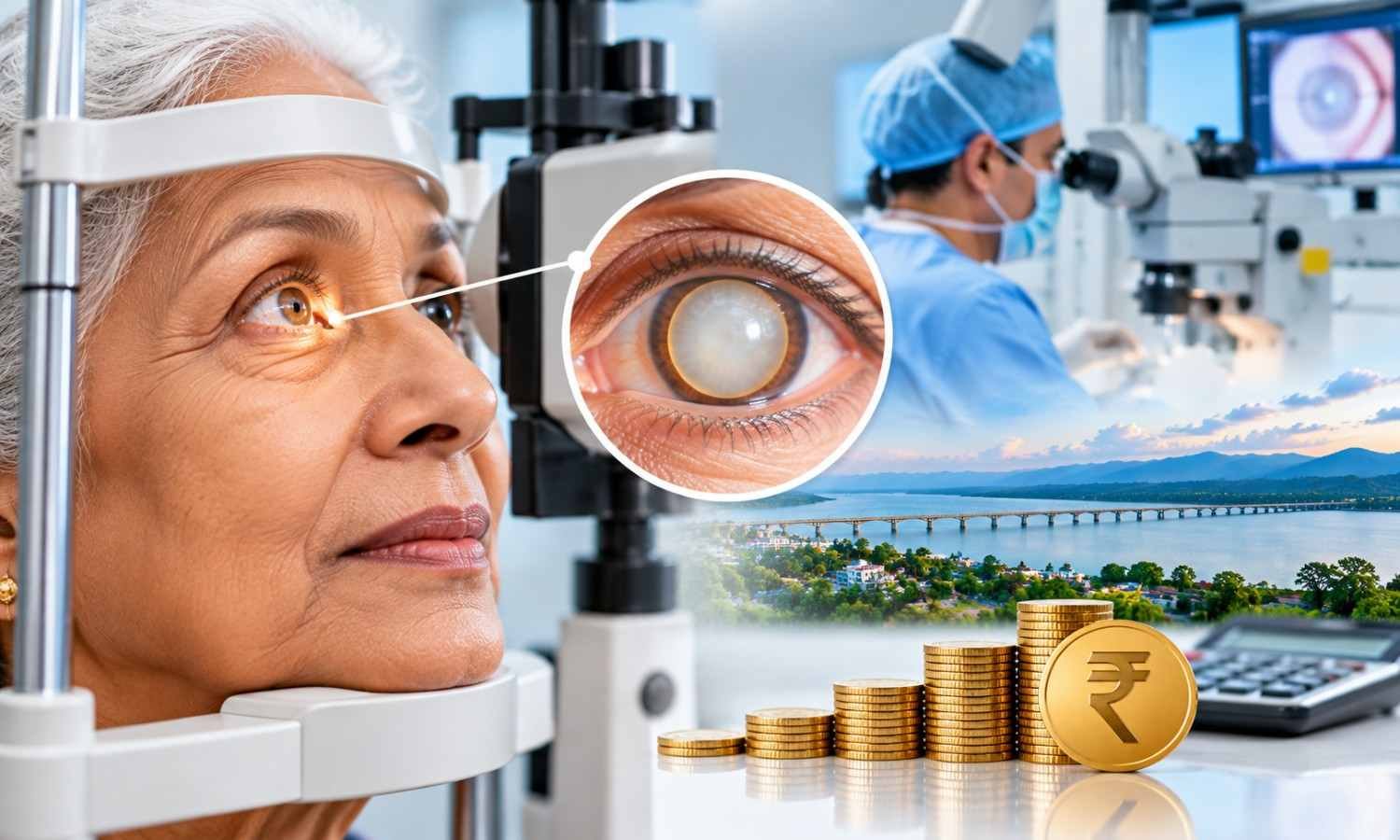
How Much Does Cataract Surgery Cost in Dibrugarh? Factors That Affect the Cost
The short answer: At Drishti Netralaya in
Dibrugarh, cataract surgery packages range from Rs 7,500 to Rs 1,20,000.
Where you fall in that range depends mainly on two choices: the surgical
technique (SICS or phacoemulsification) and the type of lens placed in your
eye. After a short eye examination, we give you an itemised cost breakdown
before any surgery is booked.
If you or a
family member has been told you have a cataract, the first question is usually
the same: how much will it cost? It is a fair question, and it is hard to
answer online because prices in Dibrugarh, across Assam and across India vary
so widely. One clinic may quote Rs 10,000 while another quotes ten times that,
for what sounds like the same operation.
This guide
explains why, in plain language. You will see what decides the cost of cataract
surgery, what a fair package should include, which questions to ask any
hospital, and how insurance and government schemes can help. For details of the
surgery itself, see our cataract surgery in Dibrugarh page.
Why there is no single price for cataract surgery
Cataract
surgery replaces the eye’s clouded natural lens with a clear artificial lens,
called an intraocular lens or IOL. The operation is routine, but each eye and
each patient is different. Four things shape what you pay:
1.
The surgical technique you need (SICS or
phacoemulsification).
2.
The lens you choose (monofocal, EDOF, multifocal
or toric).
3.
The condition of your eye, including how dense
the cataract is and any other eye or health problems.
4.
What the package includes: tests, medicines and
follow-up care.
Let us take each in turn.
Factor 1: The surgical technique
Two techniques
are widely used in India. Both are performed without external stitches in most
cases.
|
Technique |
How it works |
Best for |
Cost impact |
|
Manual SICS (Small Incision Cataract
Surgery) |
The cloudy lens is removed whole
through a self-sealing tunnel incision. No external stitches. |
Economical. Well suited to dense,
advanced or mature cataracts. |
Usually the lower-cost route. |
|
Phacoemulsification
(Phaco) |
Ultrasound
breaks the lens into fragments, which are removed through a micro-incision of
about 2.2 to 2.8 mm. Sutureless. |
Faster
visual recovery and fewer restrictions afterwards. Preferred by many patients
who want to return to routine quickly. |
Costs
a little more than SICS. |
Neither is
simply “better”. Your surgeon recommends one after examining your eye. For
example, SICS can be the safer and more practical choice for a hard, mature
cataract, where phaco would need a lot of ultrasound energy.
Is the cheaper technique less safe?
This is a
common worry, and the evidence is reassuring. A review of nearly 80,000
surgeries at a large Indian eye hospital found no statistically significant
difference in overall complication rates between manual SICS (1.01%) and
phacoemulsification (1.11%). An earlier Pune study found phaco cost the
hospital roughly three times as much to perform as SICS, with little difference
in vision at six weeks. What matters most is the surgeon’s skill and choosing
the technique that suits your eye, not the price tag alone.
Factor 2: The type of lens
For most
patients, the lens makes the biggest difference to the final bill. A standard
monofocal lens is the usual base option. Premium lenses are designed to reduce
your dependence on glasses and add to the cost. We work with lens makers
including Hoya, Alcon, Johnson & Johnson Vision, Zeiss and Care Group.
|
Lens |
What it does |
Might suit you if |
Cost impact and keep in
mind |
|
Monofocal |
Clear, sharp distance vision.
Reading glasses are usually needed for close work. |
Driving, outdoor work, TV, teaching
at a distance. |
The usual base option and the most
economical. |
|
EDOF
(Extended Depth of Focus) |
Smooth
vision from far to arm’s length, with fewer night-glare issues than
multifocal lenses. |
Laptop-heavy
work, doctors, accountants, people who drive often. |
Premium
lens: adds to the cost. Very fine close work may still need reading glasses. |
|
Multifocal |
Usable vision at far, medium and
near distances, so many patients rarely reach for glasses. |
A mix of reading, screen and
distance tasks through the day. |
Premium lens: adds to the cost. Some
patients notice glare or halos at night while the brain adjusts. |
|
Toric |
Corrects
astigmatism (cylindrical power) along with the cataract. |
Anyone
with significant astigmatism who wants sharp distance vision. |
Premium
lens: adds to the cost. Needs precise pre-operative measurements. |
A simple way to decide: think about your day. If you
mostly drive, work outdoors or watch TV, and you are comfortable putting on
reading glasses, a monofocal lens may serve you well. If you spend hours on a
laptop, read a lot, or want to be less dependent on glasses, ask your surgeon
about EDOF or multifocal lenses. If you have astigmatism, ask about a toric
lens.
Your final
choice is always confirmed after a full eye examination. We use optical
biometry to measure your eye precisely and calculate the right lens power,
which matters for every lens type.
Factor 3: The condition of your eye and your health
Most cataracts
are straightforward. Some are not, and these can change both the technique and
the cost:
•
Very dense or advanced cataracts, which may need a
different approach or more operating time.
•
Other eye conditions such as glaucoma, or previous eye
surgery or injury.
•
Diabetes, which can affect the retina and needs careful
assessment. See our diabetic eye care and glaucoma care services.
•
Small pupils or weak support structures inside the eye,
which can make surgery more delicate.
This is why we
do not give a fixed figure without examining you. If your eye needs anything
beyond a standard operation, you will hear it from us before surgery, not on
the day.
Factor 4: What the package includes
Two quotes of
the same amount can cover very different things. When comparing hospitals, ask
exactly what is inside the price. At Drishti, the itemised estimate covers the
procedure, the lens, and the pre- and post-operative care that goes with it,
and you get it before surgery is scheduled.
Whichever
hospital you choose, use this checklist:
|
Ask about |
The question to put to
the hospital |
|
Surgery and surgeon fees |
Is the surgeon’s fee inside the
quoted package? |
|
Lens |
Which
lens is in the base price, and what exactly is the difference if I upgrade? |
|
Tests before surgery |
Are the eye measurements and any
extra tests included? |
|
Medicines |
Are
post-operative eye drops and medicines included? |
|
Follow-up visits |
How many check-ups are included, and
for how long? |
|
If
something unexpected comes up |
What
happens, and what could it cost, if my case turns out to be complex? |
Can insurance or a government scheme reduce the cost?
Often, yes. How
much depends on the scheme or policy.
Private health insurance
Many policies
cover cataract surgery. Standard monofocal lenses are commonly covered, while
the extra cost of a premium lens is often paid by the patient. Private policies
usually carry waiting periods (commonly 12 to 24 months for a condition like
cataract) and sub-limits per eye, so read your policy wording before you plan.
Our team can walk you through cashless options. See our page on insurance and cashless options.
CGHS
Drishti
Netralaya, listed as Eye Care Home, appears among the CGHS empanelled eye
centres in Dibrugarh. CGHS beneficiaries generally need a referral from their
wellness centre for planned surgery.
Ayushman Bharat and Atal Amrit Abhiyan
Cataract
surgery is the most commonly used procedure under Ayushman Bharat PM-JAY
nationally, with more than 22 lakh surgeries recorded by September 2024. Assam
also runs the Atal Amrit Abhiyan scheme. Eligibility, covered procedures and
hospital empanelment differ by scheme, so please call us on +91 6901274500
before you visit, and bring your Aadhaar and scheme card.
Free cataract camps
Under the
National Programme for Control of Blindness and Visual Impairment, free
cataract screening camps are held across Upper Assam. Drishti has worked with
Ramakrishna Mission, Digboi on camps where patients found to have cataracts
were operated on free of cost. If you live far from Dibrugarh and cannot afford
surgery, ask your local health worker or district blindness control society
about the next camp.
What to expect when you come to Drishti
Cataract care
at Drishti follows four steps:
5.
Comprehensive eye evaluation. Vision tests,
biometry to calculate your lens power, and a check of your overall eye health.
6.
Personalised surgical planning. Your surgeon
discusses the technique and lens that suit your eyes and lifestyle, and you
receive your itemised cost estimate.
7.
Day-care surgery. Most operations take about 15
to 20 minutes per eye under local anaesthesia, and you go home the same day.
8.
Recovery and follow-up. Many patients notice
better vision within 24 to 48 hours, with vision settling over 2 to 4 weeks.
Follow-up visits are scheduled at 1 day, 1 week and 1 month.
Patients from across Upper Assam
Many of our
cataract patients travel from Tinsukia, Digboi, Sivasagar, Dhemaji, Machkhowa
and beyond. Because surgery is day-care, most patients can plan a single trip
for the operation and return for follow-up checks as advised. Our centre is
near Amolapatty Railway Gate, opposite the Gymkhana Club, about a kilometre
from Dibrugarh railway station.
Should I wait for the cataract to “ripen”?
No. This is an
old belief. If blurred vision, glare or frequent changes in your glasses are
getting in the way of daily life, it is reasonable to see an eye surgeon now.
An early check gives you time to plan the right surgery, on your schedule,
before driving, reading or working becomes difficult. Waiting too long can make
a cataract harder and sometimes costlier to treat.
Frequently asked questions
How much does cataract surgery cost in Dibrugarh?
At Drishti
Netralaya, cataract surgery packages range from Rs 7,500 to Rs 1,20,000. The
final figure depends mainly on the surgical technique (SICS or
phacoemulsification), the type of intraocular lens you choose, and any special
needs of your eye. After your eye examination we give you an itemised cost
breakdown before any surgery is scheduled.
Why is there such a wide price range for cataract surgery?
Two patients
can need very different operations. A dense, advanced cataract may be best
treated with manual small incision cataract surgery (SICS) and a standard lens,
while another patient may choose phacoemulsification with a multifocal or toric
lens to reduce dependence on glasses. The technique and the lens are the two
biggest drivers of the final cost.
Is the lens included in the cataract surgery price?
Yes. Our
itemised estimate covers the procedure, the lens and the pre- and
post-operative care. A standard monofocal lens is the usual base option. If you
choose a premium lens such as multifocal, toric or EDOF, the difference in lens
cost is shown separately in your estimate.
Is the cost the same for both eyes?
Not always.
Each eye is assessed separately, and the technique or lens that suits one eye
may differ from the other. Our counsellors can give you an estimate for both
eyes at your consultation.
Which lens should I choose: monofocal, multifocal, toric or EDOF?
It depends on
your daily needs and your eye. A monofocal lens gives clear distance vision and
is the most economical, though you will usually need reading glasses.
Multifocal and EDOF lenses aim to reduce dependence on glasses at more than one
distance. A toric lens also corrects astigmatism. Your surgeon will recommend a
lens after a full examination.
Is SICS cheaper than phacoemulsification, and is it less safe?
SICS is
generally the more economical technique and is well suited to dense or advanced
cataracts. Published research from a large Indian eye hospital found no
statistically significant difference in overall complication rates between
manual SICS (1.01%) and phacoemulsification (1.11%). Phacoemulsification
usually offers faster visual recovery and fewer restrictions after surgery. The
right choice depends on your eye.
Does health insurance cover cataract surgery?
Many health
insurance policies cover cataract surgery, but terms differ. Standard monofocal
lenses are commonly covered, while the extra cost of premium lenses is often
paid by the patient. Private policies usually have waiting periods and
sub-limits, so check your policy document. Our team can help you understand
cashless options before you book.
Can I use Ayushman Bharat or Atal Amrit Abhiyan for cataract surgery at Drishti?
Cataract
surgery is among the most commonly used procedures under Ayushman Bharat PM-JAY
across India. Eligibility and hospital empanelment vary by scheme, so please
call our team on +91 6901274500 before you visit and carry your Aadhaar and
scheme card.
Are there any hidden charges?
No. You receive
a clear, itemised cost breakdown before surgery is scheduled, with no
last-minute add-ons. If your eye needs something extra, such as an additional
test or a different lens, we explain it and agree it with you first.
How long does cataract surgery take, and when can I return to normal activities?
The surgery
itself takes about 15 to 20 minutes per eye under local anaesthesia, and most
patients go home the same day. Many notice better vision within 24 to 48 hours,
and vision settles over 2 to 4 weeks. Follow-up visits are usually scheduled at
1 day, 1 week and 1 month.
Can you tell me the exact cost over the phone?
We can explain
the range and the factors over the phone, but an exact figure needs an eye
examination, including measurements for your lens. Call +91 6901274500 or book
an appointment online to get your personalised estimate.