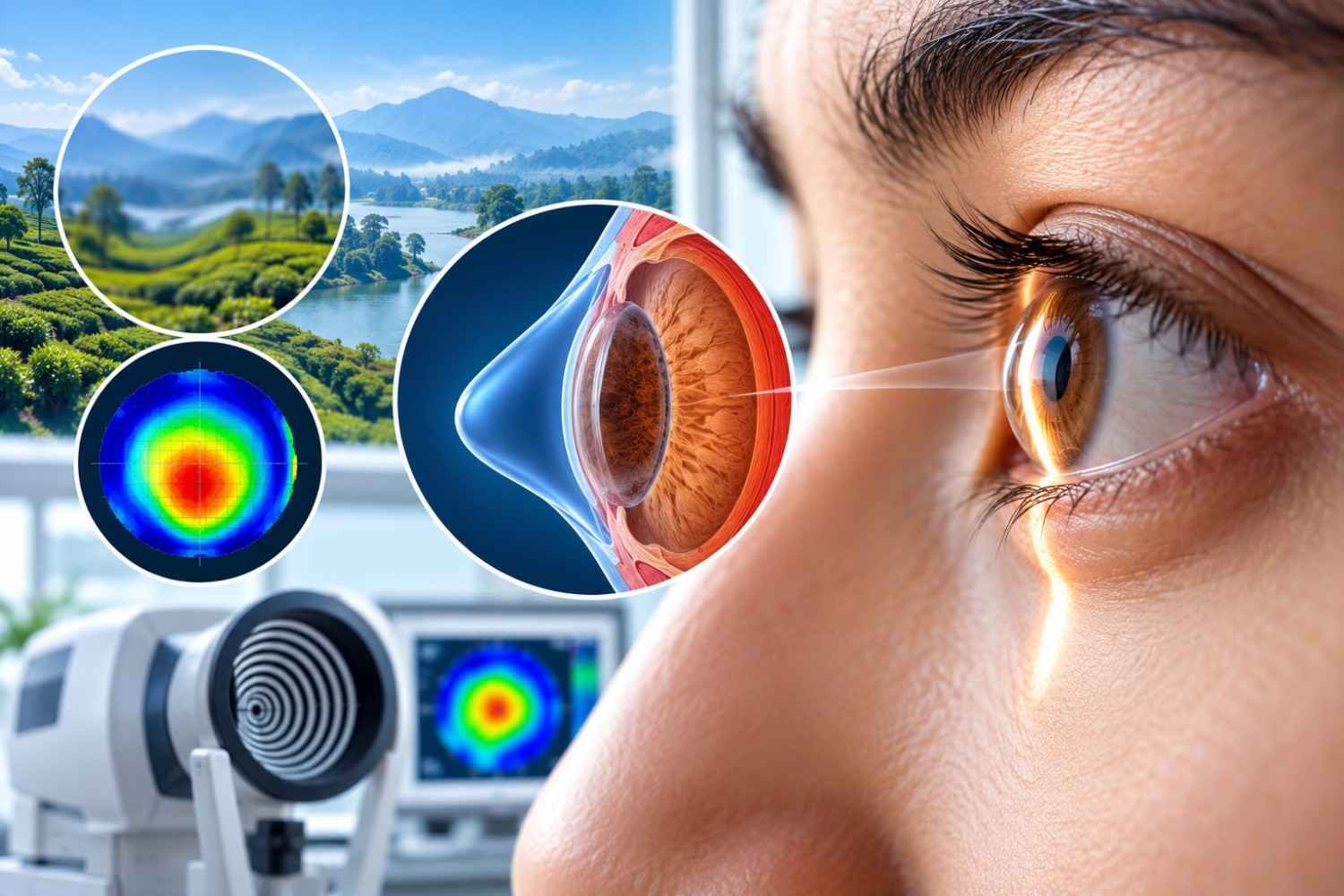
Keratoconus: Symptoms, Causes and Modern Treatment Options in Upper Assam
Keratoconus is
an eye condition in which the cornea, the clear dome at the front of the eye,
slowly thins and bulges outwards into a cone shape. This distorts the way light
enters the eye, so vision becomes blurred and warped. It often starts in the
teens or twenties, which is why it is easy to mistake for an ordinary change in
glasses number.
The good news
is that keratoconus can be monitored and treated. Glasses or specially fitted
lenses can improve vision, corneal cross-linking can help stop the cornea from
getting worse, and surgery is kept for more advanced cases. The key is to find
it early. This guide explains the symptoms, causes, tests and treatment options
in plain language, and what to do if you are in Dibrugarh or elsewhere in Upper
Assam.
What Is Keratoconus?
The cornea is
the transparent front surface of the eye. It does most of the eye’s focusing
work, and a healthy cornea has a smooth, rounded shape. In keratoconus, the
cornea becomes weaker and thinner, and the thinned area bulges forward like a
cone. The shape becomes irregular, so light is no longer focused to a single
sharp point.
Keratoconus
usually affects both eyes, although often unequally. It tends to begin in the
late teens to the early thirties and can progress slowly over 10 to 20 years.
Some people stay mild for life, while others progress and need more active
treatment. This is why it is not a one-size-fits-all condition.
What Causes Keratoconus?
The exact cause
is not known. Doctors believe that a mix of genes and environmental factors is
involved. Some points are well recognised:
•
Family history. About 1 in 10 people with
keratoconus has a parent who also has it.
•
Eye rubbing. Vigorous or habitual eye rubbing is
linked with keratoconus. It may be a habit or may be driven by itching.
•
Allergies. Eye allergies, hay fever and asthma
are associated with the condition, partly because itchy eyes lead to rubbing.
•
Certain medical conditions. These include Marfan
syndrome, Ehlers-Danlos syndrome, Down syndrome and retinitis pigmentosa.
An Indian
hospital-based study reported by LV Prasad Eye Institute found it more commonly
in men in its records, but the researcher cautioned that the reasons are not
known and that differences in who reaches hospital may play a part.
What Are the Symptoms of Keratoconus?
Early
keratoconus can be subtle, and early symptoms often look like common refractive
errors. Look out for:
•
Mild blurring, or lines that look slightly wavy or
distorted
•
Glasses numbers that keep changing, especially
astigmatism
•
Sensitivity to bright light and glare, and difficulty
with night driving
•
Ghosting or double vision in one eye, and halos around
lights
•
Eye irritation, redness or the urge to rub the eyes
As it
progresses, vision becomes more blurred and distorted, glasses stop giving
clear sight, and contact lenses may become hard to wear. Keratoconus itself is
usually painless. Pain, redness and a sudden drop in vision are not typical of
ordinary progression, so please have them checked promptly.
Who Is at Higher Risk, and Who Should Get Checked?
Consider an eye
check, with a cornea assessment if advised, when:
•
You are a teenager or young adult whose glasses keep
changing or never quite give clear vision
•
Someone in your family has keratoconus
•
You rub your eyes often, or have long-standing eye
allergies
•
You have a related condition such as Marfan,
Ehlers-Danlos or Down syndrome
•
You are thinking about laser vision correction. A
corneal assessment is an important part of deciding whether it is suitable
Having a risk
factor does not mean you will develop keratoconus, and it can occur in people
with none of them.
How Is Keratoconus Diagnosed?
Keratoconus is
diagnosed through an eye examination, often during a routine check. Your doctor
decides which tests are needed. They may include:
•
A detailed history and vision check. Including
how often your glasses have changed.
•
Slit-lamp examination. A microscope that lets
the doctor look closely at the cornea.
•
Corneal curvature measurement (keratometry). Shows
how steep the cornea is.
•
Corneal topography or tomography. A computer map
of the front, and in tomography also the back, surface of the cornea. It can
show a cone-shaped steepening before it is visible to the eye, and it is used
to track change over time.
•
Corneal thickness measurement (pachymetry). A
thin cornea is typical of keratoconus and also affects which treatments are
safe.
Because keratoconus can change over time, tests are often repeated to see whether it is progressing. That decides when treatment is needed.
What Are the Modern Treatment Options for Keratoconus?
Treatment
depends on how advanced the keratoconus is, whether it is getting worse, and
the condition of your cornea. Your ophthalmologist will advise on the plan;
this article cannot choose a treatment for any individual. The main approaches
are:
Glasses and soft contact lenses
In the early
stages, glasses or soft lenses can give good vision. As the cornea becomes more
irregular, they may stop being enough.
Rigid gas-permeable and scleral lenses
Rigid gas-permeable (RGP) lenses and larger scleral lenses create a smooth surface over an irregular cornea and often give much sharper vision than glasses. They need a careful specialist fitting and good lens hygiene. They improve vision but do not, on their own, stop the cornea from changing. Our contact lens clinic page lists RGP and scleral lenses for irregular corneas.
Corneal cross-linking (CXL)
Cross-linking
is designed to strengthen the cornea. Riboflavin (vitamin B2) drops are applied
to the cornea, which is then exposed to ultraviolet light. This increases the
links between collagen fibres and can help stop keratoconus from getting worse.
It aims to stabilise the cornea rather than reverse changes that have already
happened, so vision is not usually restored to normal by CXL alone. It is
generally considered when keratoconus is progressing, and glasses or lenses are
still usually needed afterwards. Like any procedure, it has risks, which your
doctor will explain.
Corneal implant rings (Intacs)
In some
moderate cases, tiny curved segments are placed in the cornea to flatten and
regularise its shape. Whether this suits you depends on your corneal
measurements.
Corneal transplant
A transplant is
kept for advanced keratoconus, such as when scarring is present or lenses can
no longer give useful vision. In deep anterior lamellar keratoplasty (DALK) the
front layers are replaced and your own inner layer is kept. In penetrating
keratoplasty (PK) the full thickness of the cornea is replaced. The choice
depends on the condition of the cornea. A transplant depends on donor tissue
from an eye bank.
Outcomes
vary from person to person. No treatment can promise a particular result, and
some people need more than one approach over time. The earlier keratoconus is
found, the more options there usually are.
Can Keratoconus Be Prevented?
Keratoconus
cannot be reliably prevented, and no supplement or lifestyle change can promise
to stop it. You can, however, lower the chance of it worsening and catch it
early:
•
Try not to rub your eyes. If they itch, ask your doctor
about treating the allergy instead
•
Have an eye and cornea check if your glasses keep
changing or if there is a family history
•
Follow your doctor’s review schedule so that
progression is noticed in time
•
If you wear contact lenses, follow hygiene advice and
seek same-day care for pain, redness or light sensitivity
How Often Should You Get Checked?
There is no
single schedule. How often you need to be seen depends on your age, how
advanced the keratoconus is, and whether it is changing. People whose
keratoconus is progressing, especially younger people, are usually reviewed
more closely. It can continue to change into the 30s and sometimes 40s, so
ongoing monitoring matters. Your ophthalmologist will tell you the right
interval.
Because
keratoconus can run in families, your doctor may suggest checking close
relatives, particularly if they have blurred vision or frequently changing
glasses.
Keratoconus Care in Dibrugarh and Upper Assam
Keratoconus can
affect people anywhere, and living in Upper Assam does not by itself decide
your risk. Because it often starts in young people and looks like a simple
glasses problem, it can go unrecognised for years, and treatments such as
cross-linking work best when the cornea is still stable enough to be protected.
Drishti
Netralaya’s cornea page states that it treats keratoconus, with initial
consultations at its Dhemaji and Machkhowa centres and treatment and surgery at
the main hospital in Dibrugarh. It describes glasses or rigid lenses for milder
disease, cross-linking for progressing disease, and corneal transplant (PK and
DALK) for advanced disease, supported by a partnership for donor tissue.
Please note
that the website does not describe the diagnostic tests (such as corneal
topography) used for keratoconus.
To ask about an
examination, call +91 6901274500 (also on WhatsApp) or use the contact
page. If you are considering vision correction, our LASIK and refractive surgery page explains
that a corneal assessment comes first.
Frequently
Asked Questions
What is keratoconus?
Keratoconus is
a condition in which the cornea, the clear front of the eye, gradually thins
and bulges into a cone shape. This distorts vision and often makes glasses
changes frequent.
At what age does keratoconus start?
It usually
begins in the teens or twenties and can continue to change into the 30s and
sometimes 40s. It can occasionally start earlier or later.
Is keratoconus painful?
Usually not.
Keratoconus itself is typically painless. Sudden pain, redness, light
sensitivity or a sudden drop in vision need prompt examination, as they can
mean an infection or a sudden corneal swelling.
Can keratoconus be cured?
There is no
cure that restores a normal cornea shape, but it can be managed. Treatments aim
to stabilise the cornea and improve vision.
Can keratoconus be stopped from getting worse?
Corneal
cross-linking is designed to help halt progression, and your doctor can tell
you whether it suits you. Monitoring is needed because keratoconus can change
over many years.
Does cross-linking reverse keratoconus?
Usually not. It
aims to stop further change rather than undo existing change, so lenses or
glasses are often still needed afterwards.
Can glasses correct keratoconus?
Glasses can
help in the early stages. As the cornea becomes more irregular, rigid or
scleral lenses often give clearer vision.
Is keratoconus genetic, and does eye rubbing cause it?
Genes play a
role, and about 1 in 10 people with keratoconus has an affected parent. Eye
rubbing is linked with it, so avoiding rubbing is sensible, although the cause
is not fully understood.
Can I have LASIK if I have keratoconus?
Standard LASIK
is generally not considered suitable for keratoconus because it thins the
cornea. A corneal assessment is needed before any laser vision correction, and
your doctor can explain the options.
Do I need a corneal transplant?
Most people
with keratoconus do not. A transplant is considered mainly in advanced cases,
for example with scarring or when lenses can no longer give useful vision.
Can keratoconus cause blindness?
Advanced
keratoconus can scar the cornea and seriously reduce vision, and some people
need a transplant. With monitoring and timely treatment, many people keep
useful vision.
Conclusion:
Get Your Eyes Checked
Keratoconus
often starts quietly, with blurred vision, light sensitivity and glasses that
keep changing. It can be monitored and treated, and the earlier it is
recognised, the more options you usually have. A check cannot promise that no
vision will be lost, but it gives the best chance of finding a problem while
treatment can still help.