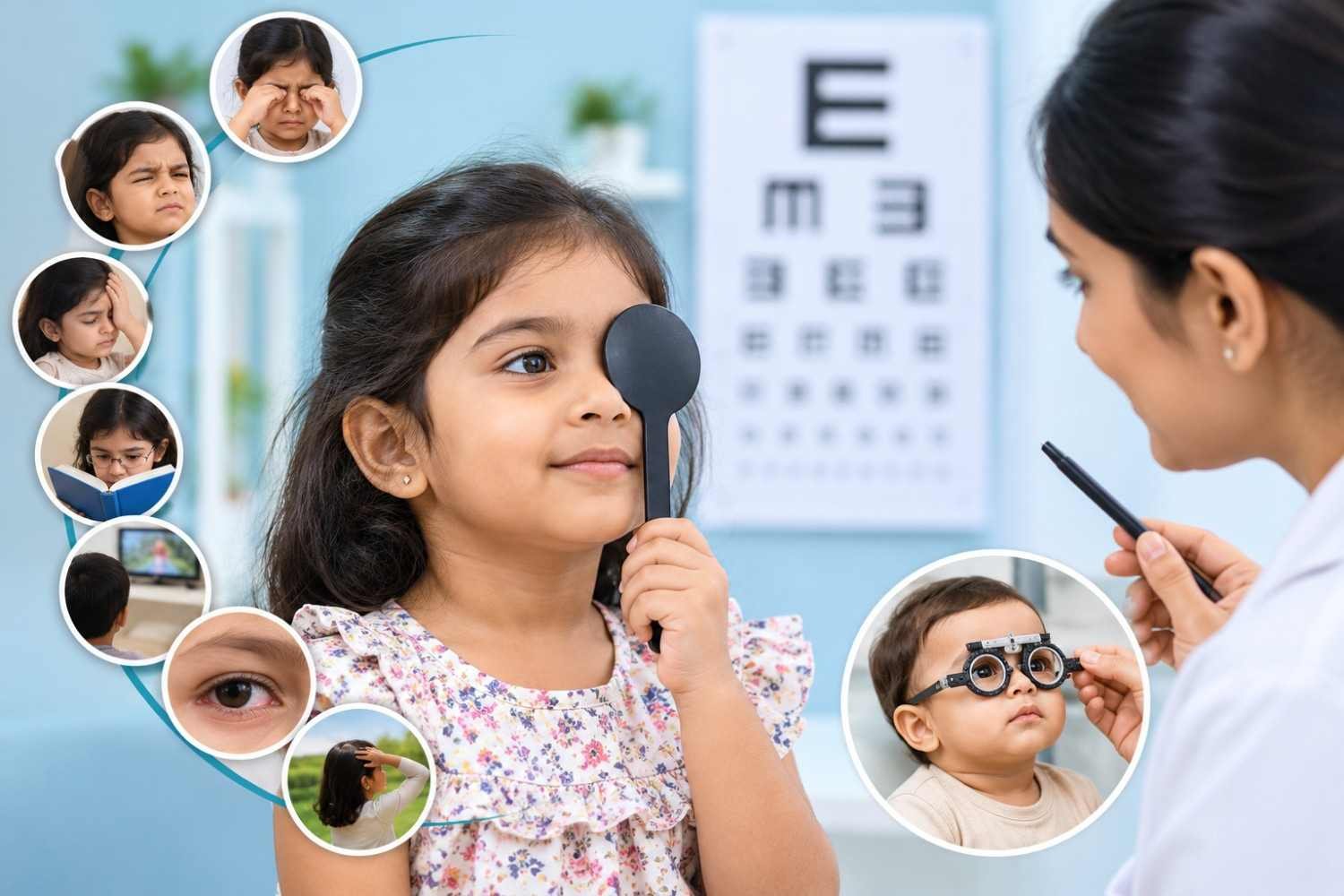
7 Signs Your Child May Have a Vision Problem and the Right Age for a First Eye Test
Children rarely complain that they cannot see well. A child who has always seen the world a little blurred has nothing to compare it with, and a young child often cannot describe what they see. That is why parents are the first to notice, and why eye checks should not wait until a problem is obvious. This guide lists seven signs worth acting on and explains the ages at which a child’s eyes should be checked.
7 Signs Your Child May Have a Vision Problem
1. Sitting Very Close to the TV, or Holding Books and Phones Close
A child who keeps moving closer to the screen, or holds books, tablets or phones very near the face, may be trying to see more clearly. Drishti Netralaya’s paediatric page lists this among the signs that call for an eye examination.
2. Squinting, Frowning, or Closing or Covering One Eye
Squinting or frowning to focus, especially at close range, can mean the eyes are working hard to see clearly. A child who closes or covers one eye, for example outdoors in bright light, or who resists having one eye covered, should also be examined. The American Family Physician review lists resisting a covered eye and squinting with one eye as signs that raise suspicion of amblyopia (lazy eye).
3. Eyes That Turn, Drift or Look Unequal
One eye that turns inward, outward, upward or downward, either all the time or now and then, is called a squint (strabismus). It may be more noticeable when the child is tired. A drooping eyelid, or eyes that look unequal in size or shape, also needs assessment. Do not wait for a squint to “grow out of it”.
4. Head Tilting or Turning to Look at Things
A child who regularly tilts or turns the head to look at something may be compensating for an alignment or focusing problem. Both the American Family Physician review and Drishti Netralaya’s squint page list abnormal head position as a sign.
5. Trouble Seeing the Board, or Difficulty Reading
Difficulty seeing the board at school, losing the place while reading, avoiding reading, or headaches after reading or studying can point to a refractive error (myopia, hypermetropia or astigmatism) or another focusing problem. These are often mistaken for lack of interest or attention.
6. Frequent Eye Rubbing, Redness or Watering
Frequent eye rubbing, redness, watering, discomfort or pain should be checked. Excessive tearing that continues beyond the first year of life, despite simple measures, is a reason for referral to an eye specialist.
7. Bumping Into Things or Seeming Clumsy
Poor depth perception can show up as bumping into things on one side or appearing unusually clumsy. If one eye sees better than the other, the child may not notice, because the better eye does the work.
What Is the Right Age for a First Eye Test?
There is no single fixed age for a first eye test, and Drishti Netralaya’s paediatric page says the same. What doctors recommend is a series of checks as a child grows, with an eye specialist’s examination sooner if there is a risk factor or a sign. The American Academy of Ophthalmology describes this schedule:
| Age | What Is Checked |
|---|---|
| Newborn | A doctor or trained health professional checks basic eye health, including the red reflex, blinking and pupil response. |
| 6 to 12 months | A second screening, usually at a well-child visit, checking the eyes visually along with alignment and movement. |
| 12 to 36 months | A check for healthy eye development; photoscreening (a test that photographs the eyes) may be used to find problems that can lead to amblyopia. |
| 3 to 5 years | Vision and eye alignment are checked; visual acuity is tested once the child can read an eye chart. |
| 5 years and older | Visual acuity and alignment are screened. |
A child should see an ophthalmologist earlier if they were born prematurely, have signs of eye disease, or have a family history of childhood eye disease such as amblyopia, squint, retinoblastoma, congenital cataract or glaucoma. A child who fails a screening, or has a vision complaint or abnormal visual behaviour, should also have a full eye examination.
Why Early Detection Matters
Amblyopia, or lazy eye, is reduced vision in an eye that has not developed normally. The American Family Physician review states that early detection through vision screening before seven years of age is crucial, and that without treatment amblyopia can lead to irreversible, lifelong visual deficits. It identifies ages three to five as the critical period for treatment. Treatment can include glasses, patching the stronger eye, eye drops, and in some cases surgery. Drishti Netralaya’s paediatric page notes that untreated vision problems can affect how a child’s visual system develops.
What Happens at a Child’s Eye Examination
At Drishti Netralaya’s paediatric services, a child’s eye examination includes a history, vision and alignment testing, refraction if needed, and an eye health check. Because very young children cannot complete most adult vision tests, tests are chosen to suit the child’s age. Depending on what is found, treatment may include glasses, amblyopia therapy, vision therapy, prism glasses, monitoring, medical treatment or surgery when clinically indicated. Our squint and paediatrics page explains how squint and lazy eye are assessed and treated.
What Parents Can Do
Make sure your child’s eyes are checked at the stages above, even if there are no complaints.
Watch for the seven signs, and ask your child’s teacher whether they have noticed difficulty with the board or reading.
Tell the doctor about any family history of squint, lazy eye, high refractive error or childhood eye disease.
If a screening result is unclear, follow up rather than waiting; a repeat check or a full eye examination may be advised.
Do not wait for a squint or head tilt to settle on its own.
Getting Help in Dibrugarh and Upper Assam
Drishti Netralaya’s paediatric eye care is led by Dr. SuvarnaBalankhe, a visiting consultant, so please call ahead to confirm her visit before you come.
Call the main hospital on +91 6901274500 (also on WhatsApp) or visit Amolapatty Rly Gate, Dibrugarh.
You can also book an appointment.
Frequently Asked Questions
At What Age Should a Child Have the First Eye Test?
There is no single fixed age. Doctors recommend a newborn eye check, a second screening between 6 and 12 months, a check for healthy development between 12 and 36 months, and a vision and alignment check at 3 to 5 years. A child with a risk factor or a warning sign should see an eye specialist sooner.
What Are the Signs of a Vision Problem in a Child?
Common signs include sitting very close to screens, squinting or covering one eye, eyes that turn or look unequal, head tilting, trouble seeing the board or reading, frequent eye rubbing or watering, and bumping into things.
Can a Baby Have an Eye Test?
Yes. A newborn has a basic eye health check, including the red reflex test, and a second screening is usually done between 6 and 12 months. Babies cannot read a chart, so doctors check how the eyes look, line up and move.
What Is Lazy Eye (Amblyopia)?
Amblyopia is reduced vision in an eye that has not developed normally. Without treatment it can lead to lasting vision loss, which is why early detection and treatment matter.
Will My Child Grow Out of a Squint?
Do not assume so. A child with eyes that turn or drift, constantly or now and then, should have an eye evaluation.
Does My Child Need an Eye Test If They Have No Complaints?
Yes. Young children often cannot describe what they see, and some problems, such as amblyopia, need to be found early. Screening at the recommended ages is meant to find problems before symptoms are obvious.
When Should a Child See an Ophthalmologist Rather Than Only a Screening?
If a child was born prematurely, has signs of eye disease, has a family history of childhood eye disease, fails a vision screening, or has a vision complaint or abnormal visual behaviour.
What Happens at a Child’s Eye Examination at Drishti Netralaya?
It includes a history, vision and alignment testing, refraction if needed, and an eye health check. Treatment depends on the findings and may include glasses, amblyopia therapy, vision therapy, prism glasses, monitoring, medication or surgery.
Conclusion
A child’s eyes are still developing, and the best time to find a problem is early. Have your child’s eyes checked at the recommended ages, and do not wait for school or for a complaint if you notice any of the signs above.